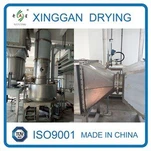


Spray drying can be used for a wide range of applications requiring the production of free-flowing powders. This method of dehydration has become one of the most successful in the following areas: Pharmaceuticals, Bone and Dental Fillings, Beverages, Flavors, Pigments and Plant Extracts, Milk and Egg Products, Plastics, Polymers and Resins.
The spray dryer drying process is generally possible than imagined. The earliest date is from 1860 and the first patented design description is recorded in 1872. The basic idea of a spray dryer is the highly dispersed production of powder feed from liquid by evaporating the solvent. This is accomplished by mixing heated gas atomized (sprayed) fluid with high surface-to-mass ratio water droplets, ideally of equal size, in a container (drying chamber), causing the solvent to evaporate evenly and rapidly by direct contact.
Almost all other drying methods, including the use of ovens, freeze dryers or rotary evaporators, produce large quantities of material that require further processing (such as grinding and sieving) and therefore, produce particles of irregular size and shape. Spray dryers, on the other hand, offer a very flexible control over powder particle properties such as density, size, flow characteristics and moisture content.
The constant speed stage ensures rapid evaporation of moisture from the particles on the surface. This is followed by a period of decreasing rate of drying at the surface which is controlled by the diffusion of water particles. Separation of powders from wet gases: carried out in an economical (eg recovery of drying medium) and optimal way. Particulates are usually removed with cyclones, bag filters, dust collectors or scrubbers. Cool and pack.
https://www.stardrying.com/